- Daily Pnut
- Posts
- A Massacre In Sudan & The U.S.-China Trade Deal
A Massacre In Sudan & The U.S.-China Trade Deal
A Big Day For AI & The Fed's Rate Cut

Marcus Gee-Lim
October 30, 2025

Hello, readers – happy Thursday! Today, we’ll be talking about the growing AI bubble, Sudan’s civil war, the Trump-Xi meeting, the Gaza ceasefire, the Fed’s rate cut, a secret order to the National Guard, and the Azure outage.

“Youth is happy because it has the capacity to see beauty. Anyone who keeps the ability to see beauty never grows old.” ― Franz Kafka

The Bubble Gets Bigger

“Jensen Huang at Computex Taipei” by NVIDIA Taiwan via Flickr. CC BY 2.0.
The lion does not concern itself with talk of an AI bubble. Yesterday, two of the world’s biggest AI companies – Nvidia and Google – celebrated big financial milestones even as analysts and investors continued to ring the “it’s a bubble” bell.
On Wednesday, Nvidia became the world’s first publicly-traded company to reach a valuation of over $5 trillion, topping off its monstrous growth over the past few years by adding $1 trillion to its value over just four months. The company’s stock has exploded thanks to the rise of AI chatbots like OpenAI’s ChatGPT and Google’s Gemini because Nvidia’s graphics processing units (GPUs) are best-in-class for all the computing tasks needed to train and operate AI models. So every time a country or company says they’re investing billions of dollars into AI data centers, a large chunk of that cash is going straight to Nvidia.
Google’s parent company Alphabet announced its third-quarter earnings yesterday as well. From July 1 to September 30, the tech giant said it earned a whopping $102.4 billion, beating Wall Street’s prediction of $99.85 billion. A large chunk of that earnings growth came from its Google Cloud remote computing division, which saw revenues rise 34% from $11.4 billion over the same period last year to $15.2 billion this year. “We have signed more deals over $1 billion through Q3 this year than we did in the previous two years combined,” said Alphabet CEO Sundar Pichai in the company’s earnings call. Even Google’s AI rivals like Meta and Anthropic have become Google Cloud customers as they struggle to secure AI computing capacity.
What does this all mean? Not much for the average person, except for the fact that your retirement account is increasingly reliant on these AI companies succeeding. At this point, Nvidia alone makes up about 8% of the S&P 500’s value, while the Magnificent Seven (Nvidia, Apple, Microsoft, Meta, Amazon, Alphabet, and Tesla) make up more than a third of the index.
The Incivility Of Sudan’s Civil War
According to the World Health Organization and the Sudan Doctors Network, Sudan’s Rapid Support Forces (RSF) paramilitary group murdered hundreds of civilians in a hospital on Tuesday. The RSF is one of two main parties involved in the Sudanese civil war, with the Sudanese Armed Forces (SAF) being the paramilitary group’s main opposition.
The violence reportedly occurred at the Al Saudi hospital in the Sudanese city of El Fasher, with RSF soldiers killing 460 people. According to the Yale Humanitarian Research Lab, satellite imagery of the hospital captured on Monday and Tuesday shows three piles of white objects and a “reddish discoloration on the ground” appearing on Tuesday after the massacre allegedly occurred. RAF forces had just seized control over the city on Sunday, granting the militia control over all five regional capitals of Sudan’s southeastern Darfur region.
The RSF and SAF have been engaged in a struggle for power over Sudan since 2023, when the leaders of each group split over plans to roll up the RSF into SAF. The RAF, which has received backing from the United Arab Emirates, has been accused of ethnically cleansing Sudan’s non-Arab populace, while the SAF has also been accused of war crimes and targeting civilians. Analysts say that the civil war could lead to yet another partition of Sedan following the blueprint of South Sudan’s 2011 secession, with the RSF moving to establish power over the parts of the country that it currently controls.

Earlier today in South Korea, Trump met with Chinese President Xi Jinping on the sidelines of the Asia-Pacific Economic Cooperation summit in South Korea. According to the president, the U.S. will reduce its tariffs on China from 57% to 47% – in exchange, Beijing will resume its purchases of U.S. soybeans, promise to keep rare earths exports flowing at current levels, and shut down the flow of fentanyl precursors to international drug cartels.
“I thought it was an amazing meeting,” Trump told reporters after leaving South Korea. The two leaders agreeing on a trade deal eases fears of a trade war between the two biggest economies in the world. Trump referred to Xi as a “friend” and “great leader,” while the Chinese premier said he had a “warm” feeling after meeting with the U.S. leader. While the two countries “do not always see eye to eye,” he said, the countries should be “partners and friends.”
Is It A Ceasefire If The Fire Doesn’t Cease?
On Tuesday, Israel bombarded Gaza with airstrikes, killing at least 104 people. The massive bombing campaign was a response to Hamas allegedly killing an IDF reservist behind the “Yellow Line,” which separates IDF-held territory from the rest of Gaza. Israel continued bombing the enclave on Wednesday – according to the Israeli military, the strikes targeted Hamas military infrastructure where the group has (allegedly) been storing weapons for an attack in northern Gaza.
Despite the violence, the Trump administration says the Israel-Hamas ceasefire is still intact. “They killed an Israeli soldier. So the Israelis hit back. And they should hit back,” he told the press aboard Air Force One. The weeks’ casualties in Gaza have reached levels not seen since almost a month before the ceasefire took effect. When asked whether Tuesday’s bombing campaign is an indication that Israel might continue its full-scale invasion of Gaza, a spokesperson for the IDF said that the military “can’t elaborate on the scale yet.”
More Mixed Nuts
Dutch centrist D66 party wins big in election as far right loses support (Reuters)
South Korea awards Trump gold crown amid deal to unlock $350bn trade talks (Guardian)
‘This was a slaughter, not an operation’: the favela reeling from Rio’s deadliest police raid (Guardian)
Video Analysis Shows Staged Recovery of Israeli Hostage Remains (NYT, $)
Trump says South Korea has approval to build nuclear-powered submarine (Reuters)
Iran isn't actively enriching uranium but movement detected near nuclear sites, UN official tells AP (AP)

Snip-Snip, That’s The Sound Of The Federal Reserve
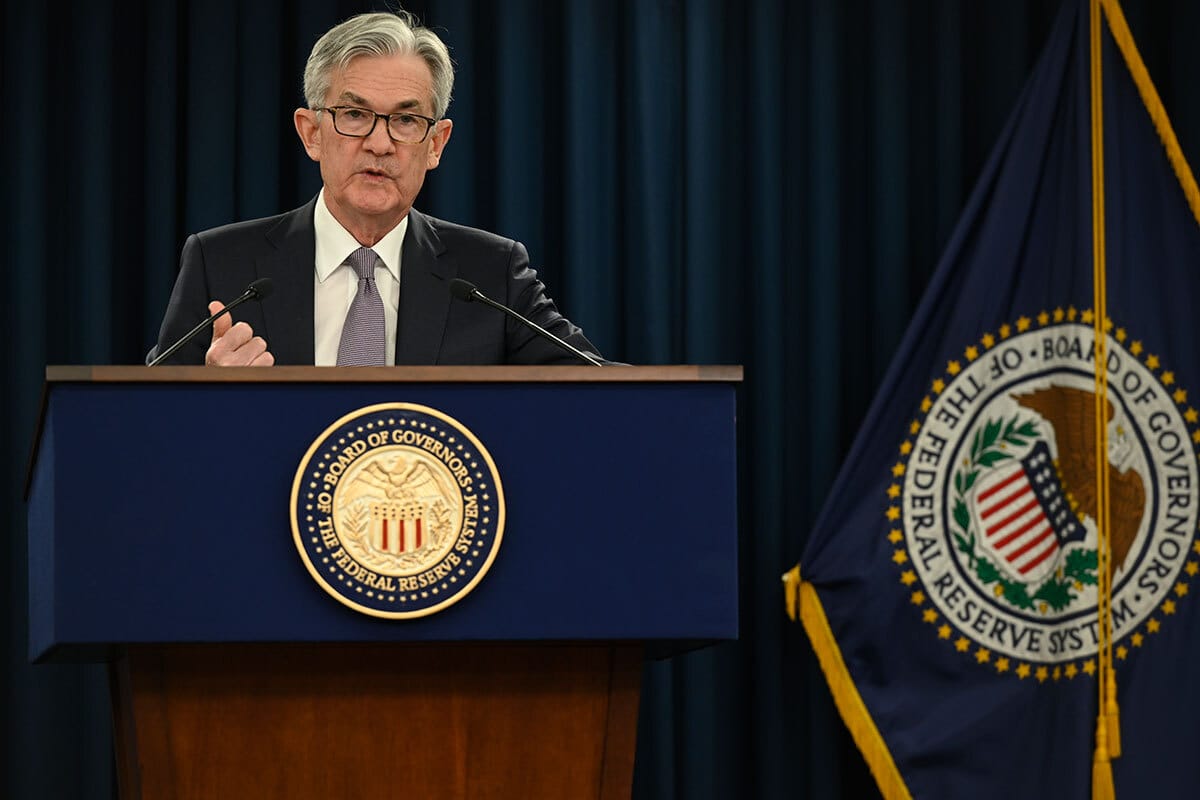
“FOMC Chair Powell” by Federal Reserve via Flickr.
The Federal Reserve cut interest rates for the second straight month yesterday, bringing rates down a quarter percent (from 4%-4.25% to 3.75%-4%). While the Fed had previously indicated that it would cut rates three times this year (which would mean another rate cut is scheduled for December), Chair Jerome Powell told the press, “A further reduction in the policy rate at the December meeting is not a foregone conclusion. Far from it.”
Rate cuts make money more accessible throughout the economy, especially for businesses. The Fed is hoping that making it easier for businesses to make money will help deal with the U.S.’s growing unemployment problem – according to the Federal Open Market Committee, the economy has seen “downside risks to employment” grow over the past few months. While the Trump White House has been pushing the Fed to cut rates further, the bank also needs to monitor inflation rates, which rise as interest rates go down. The annual rate is hovering at roughly 3%, well above the Fed’s 2% annual target.
What Is The Guard Guarding, Exactly?
In a memo signed on October 8, Major General Ronald Burkett ordered the National Guard departments across the U.S. to prepare “quick reaction forces” for “riot control.” Burkett, the director of operations for the Pentagon’s National Guard Bureau, ordered each state (plus D.C. and every U.S. territory) to train at least 500 National Guard soldiers to use batons, body shields, Tasers, and pepper spray. The order, according to former US Marine Corps captain Janessa Goldbeck, will establish “a national, militarized police force” 23,500 members strong.
While the White House claims that it will deploy the National Guard force in order to lower crime rates in Democrat-led cities, Goldbeck says that the force could be used to threaten voters in the 2026 midterm elections. “The president could declare a state of emergency and say that elections are rigged and use allegations of voter fraud to seize the ballots of secure voting centers,” she told the Guardian. Why all the focus on voting? The memo states that the Pentagon will send military trainers to every state and territory with the goal of having the National Guard forces “operational” by January 1, 2026, just a few months before the 2026 midterm season kicks off in April.
More Nuts In America
Kash Patel scrambled government jet to watch girlfriend sing at wrestling bout, report says (Independent)
CBS News staffers lose jobs in ‘bloodbath’ as part of sweeping cuts from Paramount (Guardian)
Trump directs nuclear weapons testing to resume for first time in over 30 years (BBC)
Trump administration says it struck another alleged drug boat in Pacific, killing 4 (CBS)
Ex-Illinois Deputy Convicted in Fatal Shooting of Sonya Massey (NYT, $)
Federal shutdown could cost US economy up to $14 billion (Reuters)

 | Refer 20 friends, family members, or co-workers and win a free Daily Pnut Spiral Notebook where you can practice putting the news into a nutshell yourself! Spread the word by helping others become more educated and entertained, and get rewarded with some free Daily Pnut swag. |

Azure Goes Down, $MSFT Goes Red
Last week it was Amazon, this week it’s Microsoft. Yesterday, Microsoft’s Azure cloud computing service suffered an outage, taking down a wide range of internet services with it. Microsoft 365, the company’s productivity software suite, was among those victims; the websites for Starbucks, Alaska Airlines, London’s Heathrow Airport, and Kroger were also taken down in the outage. According to Microsoft, the Azure outage was caused by “DNS issues,” the same problem that took down Amazon Web Services (AWS) last week.
Meanwhile, Microsoft issued its third-quarter earnings report yesterday. The firm reported revenues of $77.7 billion between July and September, beating Wall Street’s projections of $75.5 billion. The Azure division drove much of that growth, with revenues jumping by 40% over that period thanks to AI companies scrambling for access to compute capacity. Despite that good news (for the company), Microsoft stock dropped roughly 4% after the earnings call. During the call, finance chief Amy Hood predicted that the company will likely increase its capital expenditures over the next year as it builds out datacenters and other AI-related infrastructure to meet the market’s hunger for computing power.
More Loose Nuts
Scans shed light on changes in brain when we zone out while tired (Guardian)
A humming annoyance or jobs boom? Life next to 199 data centres in Virginia (BBC)
Inside the Louvre Jewel Heist That Shocked the World (NYT, $)
Nine Movies That Break Down How Fear Works (Atlantic, $)
OpenAI has an AGI problem — and Microsoft just made it worse (Verge)
Camouflaging cars and swapping license plates: How agents make immigration arrests (NPR)
Peanut For Your Thoughts
Editor + Writer: Marcus Gee-Lim
Designer: Joe Stella