- Daily Pnut
- Posts
- A "Framework of A Future Deal" On Greenland
A "Framework of A Future Deal" On Greenland
The Tech Changing Farming & SCOTUS Draws A Line

Marcus Gee-Lim
January 22, 2026

Hi readers, happy Thursday! Today we’re covering Trump’s day at Davos, Canadian PM Mark Carney’s speech, the implications of losing biodiversity, Lisa Cook’s SCOTUS case, what ICE can do to peaceful protesters, & the tech that makes farms run.

“To love or have loved, that is enough. Ask nothing further. There is no other pearl to be found in the dark folds of life.” ― Victor Hugo

Big Don Backs Down
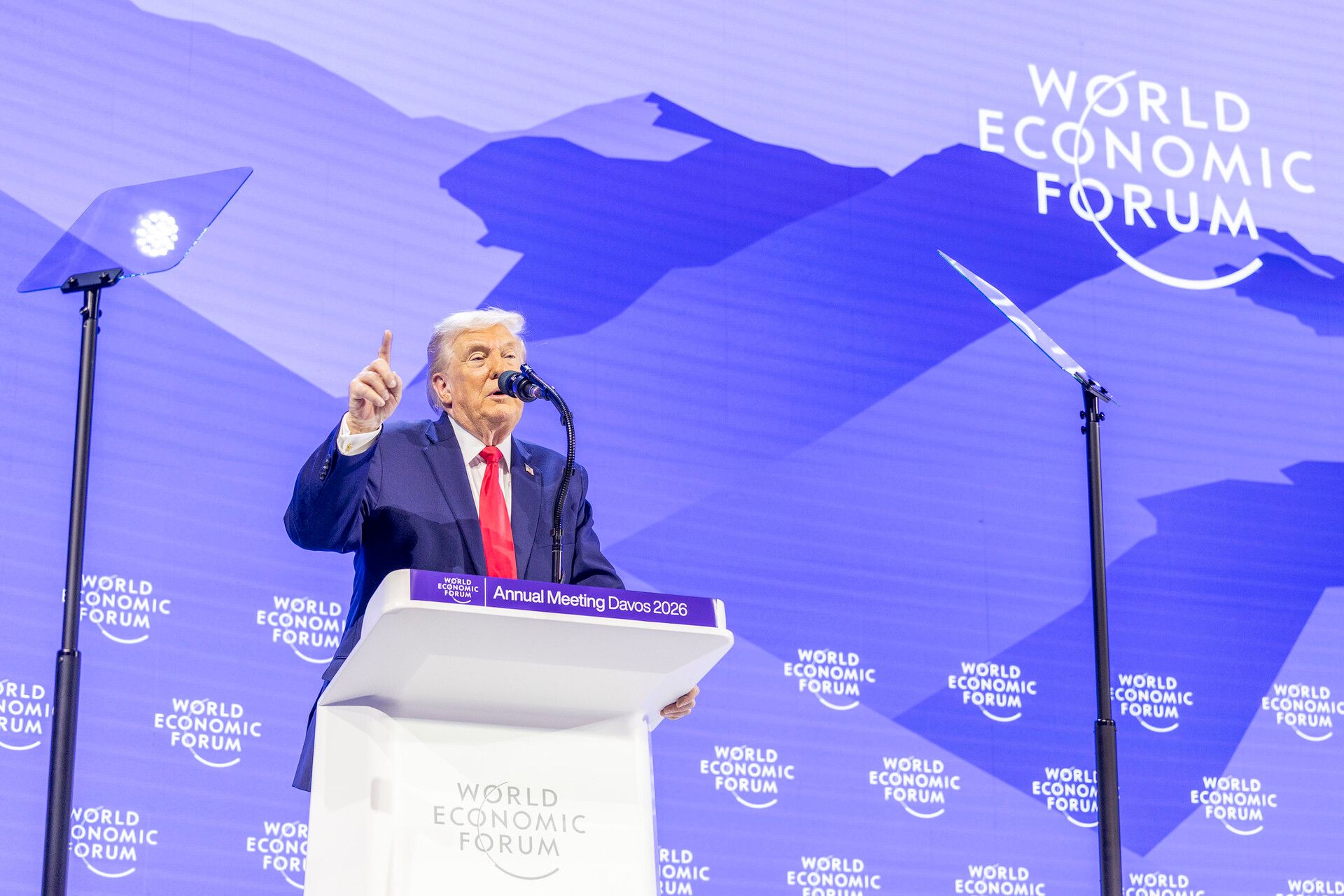
“Special Address by Donald J. Trump” by WEF via Flickr. CC BY-NC-SA 4.0.
This week, politicians, business leaders, and other powerful people descended upon the Swiss town of Davos to participate in the annual World Economic Forum. While the summit boasts 500 meeting sessions spread out over five days, most of the world was focused on one story in Davos: Donald Trump’s continued quest to bring the Danish territory of Greenland under U.S. control. For a few days leading up to the summit, Trump shocked the world by threatening NATO allies with 25% tariffs and refusing to rule out a military invasion of Greenland. Many eyes were on Davos yesterday following Trump’s crusade, with people hoping that he might work out a deal with other NATO countries at the summit.
The day started off as a mixed bag for the U.S.’s European allies. In his address, Trump made a clear announcement that he “won’t use force” to take Greenland out of Danish hands. The rest of his speech – in which he referred to Greenland as “Iceland” four times – didn’t contain very much good news for the rest of NATO. Trump criticized Denmark for being “ungrateful,” saying that the country should hand over the territory to the U.S. thanks to America’s role in defending it during World War II. He then moved on to other targets, saying that host country Switzerland was “only good because of us,” and adding that “Canada lives because of the United States.” He then told all the Europeans in the audience, “Without us right now, you’d all be speaking German and a little Japanese.”
Later, after a meeting with NATO Secretary General Mark Rutte at Davos, Trump announced in a social media post that he’d “formed the framework of a future deal with respect to Greenland and, in fact, the entire Arctic Region.” He added that the deal framework meant that he would no longer be imposing 10% tariffs on imports from 8 NATO countries that he’d threatened to implement on February 1.
As for the rest of Trump’s Davos visit, the president has announced that he plans to hold a signing ceremony for his so-called Board of Peace later today. The board initially began as a “transitional administration” that would oversee the transition of power in Gaza under Trump’s 20-point peace plan, but now seems to have become some sort of a rival to the U.N. According to a draft charter, seats on the board will cost $1 billion for countries that want to be board members for more than three years, and Trump will hold the chairmanship of the organization, granting him veto powers and the ability to dissolve the board “until he resigns it.” Saudi Arabia, Turkey, Egypt, and Israel have all indicated that they’ll join the group, and Russia and China are reportedly considering membership.

Carney Gets His Claps
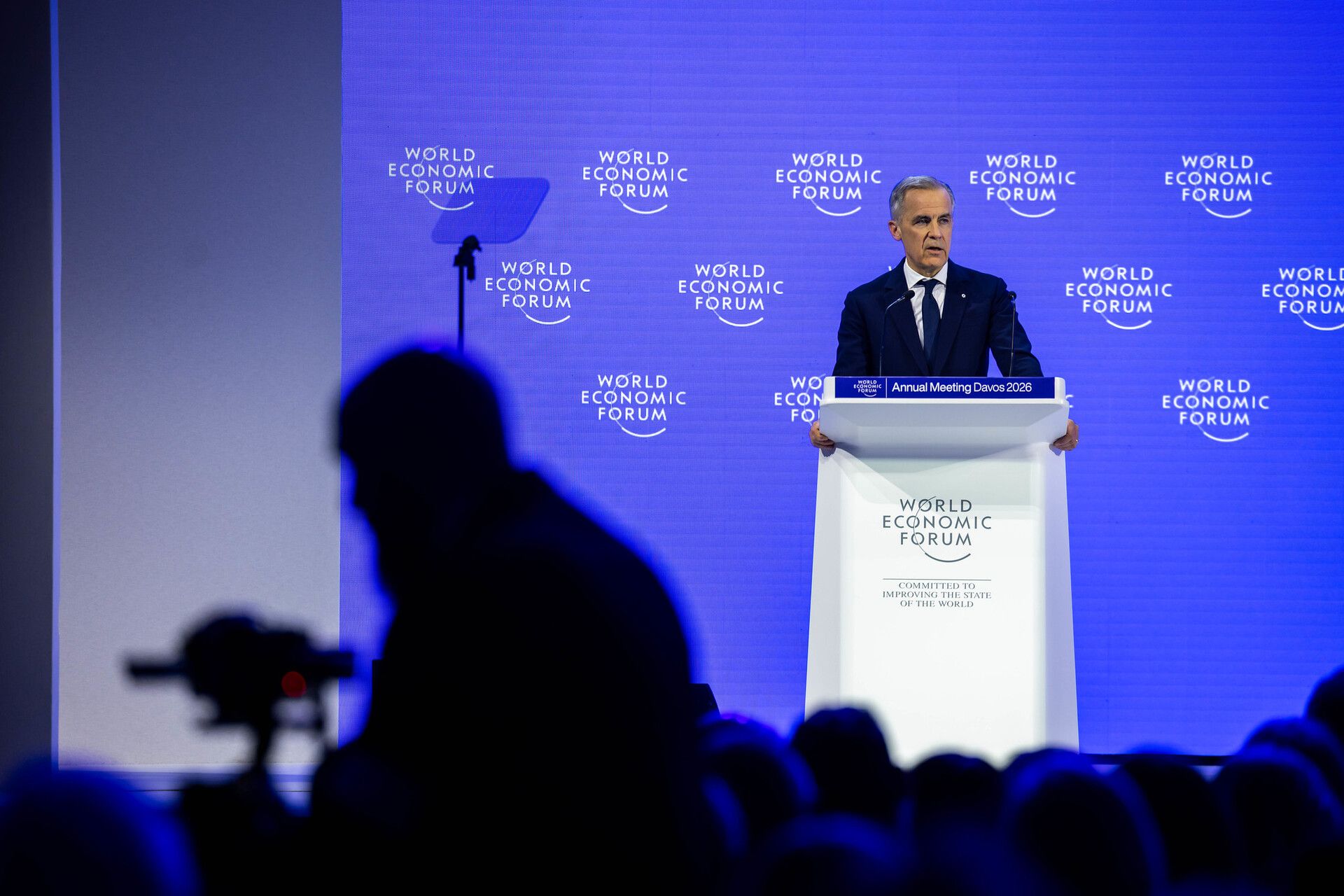
“Special Address by Mark Carney” by WEF via Flickr. CC BY-NC-SA 4.0.
While U.S. President Donald Trump was the main spectacle in Davos this week, his counterpart to the north – Prime Minister Mark Carney of Canada – also made a splash. In a speech, the former economist told his audience that they were watching the end of the era of U.S. hegemony, describing Trump’s push to control Greenland as “a rupture.”
“Every day we’re reminded that we live in an era of great-power rivalry,” Carney said. “That the rules-based order is fading. That the strong can do what they can, and the weak must suffer what they must… The middle powers must act together because if we’re not at the table, we’re on the menu.” His speech came just a few days after Carney signalled that his country would be shifting closer to China by inking a friendly trade deal with Beijing.
But the most interesting part of the speech was this: “We knew the story of the international rules-based order was partially false, that the strongest would exempt themselves when convenient, that trade rules were enforced asymmetrically. And we knew that international law applied with varying rigour depending on the identity of the accused or the victim. This fiction was useful, and American hegemony, in particular, helped provide public goods, open sea lanes, a stable financial system, collective security and support for frameworks for resolving disputes. So, we placed the sign in the window. We participated in the rituals, and we largely avoided calling out the gaps between rhetoric and reality. This bargain no longer works… You cannot live within the lie of mutual benefit through integration, when integration becomes the source of your subordination.”
No Time (For Biodiversity) To Die
According to a recent report by the U.K.’s intelligence community (but published under the Department for Environment, Food and Rural Affairs), biodiversity collapse is a major issue of national security for the U.K. In the report, government officials write that food supplies are facing serious risk unless the British government makes “significant increases” in its efforts to protect its natural resources.
Natural systems are already beginning to fail, according to the report, which cites crop failures, a rise in unusual natural disasters, and infectious disease outbreaks as examples. Intelligence officials predict that these patterns will only worsen over time, leading to “geopolitical instability, economic insecurity, conflict, migration and increased inter-state competition for resources.”
The remedy, officials write, is to focus on restoring nature both inside and outside the U.K. – that solution will allow current global trade systems to remain stable, while also protecting the country in case food imports somehow collapse. “Nature underpins our security, prosperity, and resilience and understanding the threats we face from biodiversity loss is crucial to meeting them head on. The findings of this report will inform the action we take to prepare for the future,” said a spokesperson for the Department for Environment, Food and Rural Affairs.
Additional World News
A US shift marked Kurdish-led forces' fall from power in Syria (AP)
Lords put pressure on Starmer with vote to ban social media for under-16s (Guardian)
Israel demolishes UNRWA offices for Palestinian refugees in east Jerusalem (PBS)
U.S. seizes a seventh Venezuelan-linked oil tanker in Caribbean, officials say (CBS)
Taiwan’s $40 Billion Military Spending Plan Stalled by Political Impasse (NYT, $)
Canadian man posed as a pilot and flight attendant to get hundreds of free flights, authorities say (AP)

Join the 5th Military Veteran Startup Conference (MVS) on 2/11-2/12/26. MVS is the largest convening of military veteran startup and venture capital leaders. In total the last 3 conferences brought in over 1,500 founders, future founders, operators, VCs, and LPs.
MVS26 will take place in downtown San Francisco at the Marines Memorial Club on February 11-12, 2026 (Wednesday-Thursday). The Military Veteran Startup Conference is the premier event connecting military veteran founders, VCs, institutional LPs, and operators. There is no other forum that convenes this community at scale, and past conferences have driven meaningful dealmaking, partnerships, and hiring.
Thank you to our Sponsors JPMorgan, DLA Piper, Citizens Private Bank, Sightline Ventures, Holland & Knight, Cooley & PenFed Foundation

The Court Reaches A Crossroads
Yesterday, the conservative-controlled Supreme Court appeared to indicate that it would not be allowing Trump to fire Lisa Cook, a member of the Federal Reserve Board of Governors. The Trump administration attempted to fire Cook last August, alleging that she’d engaged in “deceitful and potentially criminal conduct” by attempting to obtain loans against two different properties that she had reported as primary residences. Cook has denied any wrongdoing in the case, and her lawyers have pointed out that multiple Trump Cabinet members have recently applied for similar loans.
While the Supreme Court has sided with Trump’s attempts to override federal laws that protect certain agency heads from firing, it looks like conservative justices don’t think he should be able to fire a Fed governor. In an emergency docket opinion, the judges wrote that the Fed is different from other agencies as it’s a “uniquely structured, quasi-private entity that follows in the distinct historical tradition of the First and Second Banks of the United States.” It’s likely that they want to preserve the Fed’s separation from the executive branch, as giving Trump ground in this case would likely allow him to fire other Fed governors and appoint their replacements, handing him control over the historically apolitical financial institution.
“Spray Away,” Judge Rules
Yesterday, an appeals court temporarily lifted restrictions put in place by a federal judge which blocked ICE agents from arresting and pepper-spraying peaceful protesters in Minnesota. The restriction, imposed by Judge Katherine Menendez, was based on the argument that allowing ICE officers to detain and use “less-than-lethal” crowd control weapons on peaceful protestors had a “chilling effect” on protesters’ first amendment rights.
Last week, a federal officer used “less-than-lethal” rounds to shoot a protester in California from point-blank range. That incident left the victim, 21-year-old Kaden Rummler, blind in one eye. “I will never see through my left eye again, not even light,” he said in a statement. “I’m just glad I’m alive to tell my story.” Other protesters have reported that federal agents have fired flashbangs and tear gas canisters at them, resulting in shrapnel injuries and long-lasting concussions.
Additional USA News
Trump administration concedes DOGE team may have misused Social Security data (Politico)
The Great Crime Decline Is Happening All Across the Country (Atlantic, $)
‘No longer in my hands’: How Hill Republicans stopped caring about DOJ releasing the Epstein files (Politico)
Trump’s USDA Is Hiding the Data on Food Stamp Cuts (Mother Jones)
ICE is using Medicaid data to find out where immigrants live (Stateline)
Trump Delivered 22% Boost to Billionaire Wealth in 2025, But Catastrophe for Working Class (Common Dreams)


When Algorithms Meet The Acreage
Across the globe, farmers are working smarter (and probably harder) than ever before. According to a 2022 report by the US Department of Agriculture, while the number of farms in the U.S. has decreased over the years, those remaining farms have become increasingly “tech dense” as farmers turn to cutting-edge technologies to keep up in a competitive market.
One farmer operating a 17,000 acre farm in Saskatchewan, Canada has upgraded his tractor with new software and remote cameras. “It can look down and spray a nozzle when the sensors pick a weed, while we're going around 15 miles an hour,” he says. While the upgrades let him spend more time on other tasks, they also help him save on weed killer, making them doubly efficient. Other new tech on the market includes agri-tech giant Sygenta’s Cropwise, which allows farmers to leverage AI and satellite imagery to live-monitor their massive fields, and NoMaze, which tells farmers how to keep their plants healthy under different climate conditions.
According to a 2024 McKinsey survey, 57% of North American farmers say they’re likely to adopt new technologies over the next two years. The hope is that the tech will make farming more stable for farmers and also decrease costs for consumers. “When farmers get help to avoid crop failures, that could lead to a more controlled farm environment and a reliable and secure food system,” says one agronomist.
Additional Reads
China’s Renewable Energy Revolution Is a Huge Mess That Might Save the World (Wired, $)
CEOs Say AI Isn't Delivering Any Financial Returns yet: PwC Survey (Business Insider)
House burping: should we all adopt this German habit? (Guardian)
How the nutritional benefits of foods change as you age (BBC)
Peanut For Your Thoughts
I really recommend this manga called “Tokyo These Days” — really beautiful art and a heartfelt story.
Editor + Writer: Marcus Gee-Lim
Designer: Joe Stella